Rata & Co Face Mask Vitamin C Reviews
| I-16 | |
|---|---|
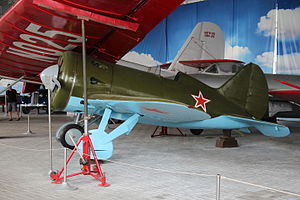 | |
| I-16 Type 5 in the Memorial Museum of Valery Chkalov, Chkalovsk, Russia | |
| Function | Fighter |
| National origin | Soviet Union |
| Manufacturer | Institute No. 21 (Gorky), Plant No. 39 (Moscow), Establish No. 153 (Novosibirsk), Plant No. 458 (Rostov-on-Don/Baku) |
| Designer | N. N. Polikarpov Design Agency |
| First flight | xxx December 1933 (TsKB-12) |
| Introduction | March 1935 |
| Retired | 1945 (Soviet Air Force), 1953 (Spanish Air Strength) |
| Primary users | Soviet Air Force Spanish Republican Air Force Chinese Nationalist Air Force |
| Produced | Nov 1934 – 1942 |
| Number built | 10,292 (6,848 fighters and three,444 trainers)[1] |
| Developed into | Polikarpov I-180 |
The Polikarpov I-16 (Russian: Поликарпов И-16) is a Soviet single-engine single-seat fighter aircraft of revolutionary design; information technology was the world's first low-wing cantilever monoplane fighter with retractable landing gear to achieve operational status and equally such "introduced a new faddy in fighter design".[ii] The I-16 was introduced in the mid-1930s and formed the backbone of the Soviet Air Forcefulness at the first of Globe War Two. The diminutive fighter, nicknamed " Ishak " or " Ishachok " ("donkey" or "burro") past Soviet pilots, figured prominently in the 2nd Sino-Japanese State of war,[3] the Battle of Khalkhin Gol,[3] Winter War and the Castilian Ceremonious War[4] [5] – where information technology was called the Rata ("rat") by the Nationalists or Mosca ("wing") by the Republicans.
Design and development [edit]
While working on the Polikarpov I-15 biplane, Nikolai Nikolaevich Polikarpov began designing an avant-garde monoplane fighter. Information technology featured cut-edge innovations such equally retractable landing gear and a fully enclosed cockpit, and was optimized for speed with a brusk chubby fuselage, and a Wright R-1820 radial engine in a NACA cowling. The aircraft is small, light and uncomplicated to build.[ citation needed ]
Full-scale piece of work on the TsKB-12 prototype began in June 1933, and the shipping was accustomed into production on 22 November 1933, a month earlier it took to the air. The TsKB-12 was of mixed construction, using a wooden monocoque fuselage and wings employing a KhMA chrome-molybdenum steel alloy wing spar, dural ribs and D1 aluminum alloy skinning on the centre and leading edges, with the remaining portions of the wings textile covered. Some other modern feature were the ailerons which ran along almost the entire abaft border of the wing and too operated every bit flaps (in the manner of more modern flaperons) past drooping 15°. The cockpit was covered by a twoscore-centimetre-wide (sixteen in) canopy which featured an Aldis-type tubular gun sight which could slide back and forth on runners fitted with prophylactic bungee cords. A 225 l (59.iv US gal) fuel tank was fitted directly in front of the cockpit. The primary landing gear is fully retractable by a hand creepo. The armament consisted of a pair of 7.62×54mmR (0.30 in) ShKAS machine guns in the wings, mounted on the outboard side of the main gear and 900 rounds of armament.[ citation needed ]
These features were proposed at first by Andrei Tupolev; however, the NII VVS was more than concerned nigh the stresses a typical gainsay aircraft was subjected to in combat, and initially considered the chance too swell. However, TsAGI, with the help of the 3rd Pattern Brigade under the leadership of Pavel Sukhoi and Aleksandr Putylov, somewhen convinced NII VVS that what was being proposed was non only feasible, simply would enhance the aircraft's performance.[ commendation needed ]
The TsKB-12 was designed for the Wright Cyclone SR-1820-F-three ix-cylinder radial engine (rated at 529 kW/710 hp); a license to build this engine under the supervision of the OKB-xix Shvetsov design agency in the Soviet Marriage was existence negotiated. Every bit the license was not yet canonical, Polikarpov was asked to settle for the less powerful K-22 (Soviet-congenital version of the Gnome-Rhone Jupiter 9ASB, which itself was a licensed version of the Bristol Jupiter Six) with 358 kW (480 hp). This was deemed acceptable because the projected top speed still exceeded 300 km/h (185 mph).[ citation needed ]
The M-22-powered TsKB-12 commencement took to the air on xxx December 1933 with the famous Soviet examination airplane pilot Valery Chkalov at the controls. The second TsKB-12, with a Cyclone engine and three-bladed propeller, flew in January of the following year. Initial government trials in February 1934 revealed very good maneuverability, only the shipping did not tolerate abrupt control inputs. Thus the TsKB-12 was accounted dangerous to fly and all aerobatics were forbidden. The M-22 version was preferred due to the vibration of the Whirlwind-powered aircraft. Pilots commented early about the difficulty of climbing into the cockpit, a trait that persisted through the I-16's service life. Earlier standing test flights the designers had to answer the question of spin behavior. Wind tunnel testing suggested that the TsKB-12, with its short tail, would enter an unrecoverable flat spin, but real-life trials were necessary to confirm this. Since Cyclone engines were rare, it was decided to risk the M-22 epitome for this purpose. On 1 and 2 March 1934, Chkalov performed 75 spins and discovered that the shipping had very benign stall behavior (dipping a wing and recovering without input from the airplane pilot when airspeed increased) and intentional spins could be easily terminated past placing the controls in the neutral position. The stories of barbarous spin beliefs of the I-sixteen perpetuated in modern literature is unfounded (maybe extrapolated from Gee Bee feel).[ citation needed ] In fact, the I-16's stablemate, the biplane Polikarpov I-153, exhibited much worse spin characteristics.[ commendation needed ]
Service trials of the new fighter, designated I-16, began on 22 March 1934. The Thousand-22 prototype reached 359 km/h (223 mph). The pioneering presence of a complex, triple-strut manually retracted main landing gear pattern was prone to jamming and required considerable forcefulness from the pilot, who directly operated the rearmost strut'south upper end, moved with a manually turned jackscrew running spanwise within the fly structure, to "slide" outwards and inwards on each side to respectively get the chief gear retracted and extended, with the chief strut (the forward-well-nigh of the trio) needing to shorten its length during its retraction to fit the mainwheel into the lower fuselage, performed by the heart-location strut's geometric arrangement and pivot locations.[6] Virtually of the test flights were performed with the gear extended. On 1 May 1934, the M-22 prototype participated in the flyover of Scarlet Square. Approximately thirty I-16 Blazon 1 aircraft were delivered, but were not assigned to whatsoever VVS fighter squadron. Most pilots who flew the I-xvi Type one for evaluation purposes did not find the aircraft to have many redeeming characteristics. Regardless of pilot opinion, much attention was focused on the Cyclone-powered aircraft and the K-25 (the license-built Cyclone). On xiv April 1934, the Cyclone epitome was damaged when one of the landing gear legs collapsed while it was taxiing.
The third image with a Cyclone engine incorporated a serial of aerodynamic improvements and was delivered for authorities trials on 7 September 1934. The summit speed of 437 km/h (270 mph) no longer satisfied the Air Force, who now wanted the experimental Nazarov M-58 engine and 470 km/h (290 mph). Subsequently, the M-22-powered version entered production at Manufactory 21 in Nizhny Novgorod and Mill 39 in Moscow. Because it was the fourth aircraft produced past these factories, information technology received the designation I-16 Type 4. Shipping fitted with these new engines required a slightly changed airframe, including armor plating for the pilot and changes to the landing gear doors (peculiarly, the hinged lower mainwheel door)[vii] to let for complete closure.
The Chiliad-25 fitted I-16, the I-16 Blazon five, featured a new engine cowling which was slightly smaller in diameter and featured 9 forward-facing, radially-set shuttered openings to control cooling airflow, a redesigned exhaust with eight individual outlet stubs, and other changes. The Chiliad-25 was rated at 474 kW (635 hp) at body of water level and 522 kW (700 hp) at 2,300 m (7,546 ft). Due to the poor quality of the canopy glazing, the I-16 Type five pilots typically left the canopy open or removed the rear portion completely. By the time the Type 5 arrived, it was the world's lightest production fighter (1,460 kg/3,219 lb), as well equally the world's fastest, able to reach speeds of 454 km/h (282 mph) at distance and 395 km/h (245 mph) at sea level. While the Type five could not perform the high-Thousand maneuvers of other fighters, it possessed superior speed and climb rates, and had extremely responsive aileron control, which gave it a very proficient roll charge per unit, which led to precision maneuvers in loops and separate-Ss.
A total of 7,005 unmarried-seat and i,639 two-seat trainer variants were produced.[ citation needed ]
Operational history [edit]
Initial service experience revealed that the ShKAS machine guns had a trend to jam. This was the result of the guns beingness installed in the wings upside-down to facilitate the fit. The problem was addressed in afterward modifications. Evaluations from pilots confirmed the experience with prototypes. Controls were lite and very sensitive, abrupt maneuvers resulted in spins, and spin behavior was fantabulous. An aileron roll could be performed in under 1.5 seconds (curl charge per unit over 240 degrees/2nd). The machine guns were fired via a cable and the required effort, coupled with sensitive controls, fabricated precision aiming hard. The rear weight bias made the I-sixteen like shooting fish in a barrel to handle on unprepared airfields because the shipping was rather unlikely to flip over the olfactory organ even if the front wheels dug in.
The I-sixteen was a hard fighter to fly. The pilots had poor visibility,[8] the canopy tended to become fouled with engine oil, and the moving portion was prone to slamming close during difficult maneuvers, which acquired many pilots to fix it in the open position. The front section of the fuselage, with the engine, was besides close to the centre of gravity, and the pilot's cockpit too far to the rear. The Polikarpov had insufficient longitudinal stability and it was impossible to wing the shipping "hands off".[9]

I-16 in Spanish Republican colors with "Popeye mascot"
Spanish Civil War [edit]
At the first of the Spanish Civil State of war in 1936, Republican forces pleaded for fighter aircraft. Later receiving payment in gold, Joseph Stalin dispatched around 475[x] I-16 Blazon 5s and Type 6s. The first I-16s appeared in Spanish skies in Nov 1936.[eleven] The Polikarpov monoplanes had their baptism of fire on xiii November 1936, when twelve I-16s intercepted a Nationalist bombing raid on Madrid. Soviet pilots claimed iv air victories and two German Heinkel He 51 pilots were killed. Just the Soviets suffered losses too; the group commander collided with an enemy aircraft and another I-16 pilot crash landed.[12] The Polikarpovs immediately began dominating the enemy Heinkel He 51 and Arado Ar 68 biplanes[ citation needed ] and remained unchallenged until the introduction of the Messerschmitt Bf 109. The arrival of the newest Bf 109Bs and the overwhelming numerical superiority of Nationalist fighters were the primary cause of the heavy I-15 and I-xvi combat losses suffered throughout 1937.[xiii] A number of aviation publications called the new Soviet fighter a "Boeing" due to the incorrect assumption that information technology was based on the Boeing P-26'due south design. The Nationalists nicknamed the stubby fighter Rata (Rat), while the Republicans affectionately called it Mosca (Wing).
Combat experience showed that the I-16 had deficiencies; several aircraft were lost after structural failure of the wings which was quickly remedied by reinforced structures. Heavy machine gun bullets could sometimes penetrate the armored backrest and fuel tanks occasionally caught burn in spite of existence protected. The hot Castilian summers required the add-on of oil radiators, and dust adversely affected the life of the engines. Although some aircraft accumulated up to 400 hours of flight time, the average life of an I-xvi was 87 days, of which one sixth was spent on maintenance. The biggest complaint in service was the light armament of only ii 7.62 mm (0.30 in) machine guns. This was urgently addressed with the Type 6 which added a 3rd ShKAS in the bottom of the fuselage. The four-gun Blazon x was nicknamed "Super Mosca" or merely "Super". The total number of I-16s delivered to Kingdom of spain from 1936 to 1938 amounted to 276. When the war ended on 1 April 1939, 187 Ratas had been lost in Spain: 112 lost in gainsay, one shot downwards past anti-aircraft fire, eleven destroyed on the ground, one force-landed and 62 lost in accidents.[14]
The Far East and battles at Khalkhin Gol [edit]

I-16 with Chinese insignia, flown by Chinese pilots and Soviet volunteers
Another 250 I-sixteen Type 10s were supplied to China. This model added a second set of vii.62 mm (0.30 in) ShKAS machine guns, armor backside the airplane pilot, and had a slightly upgraded 560 kW (750 hp) M-25 engine. In 1939, of the 500 I-16s[xv] deployed to the fighting at Nomonhan, approximately 112 were lost during the battles of Khalkhin Gol, of which 88 were destroyed in aerial gainsay, primarily against the all-metallic Nakajima Ki-27 Japanese fighters.[16] During exam trials in Russian federation of a captured Ki-27, the aircraft proved superior to the Soviet I-152 (I-15bis), I-153, and the I-16 in aerial combat, likewise as having a faster take-off and lower landing speed, requiring shorter airstrips than the I-16, which needed 270 meters to terminate and 380 meters for have-off.[17]
Further attempts were made to upgrade the firepower of the aircraft using 20 mm (0.79 in) ShVAK cannons, making the I-16 ane of the nearly heavily armed fighters of the period,[18] able to burn down 28 rounds of ammunition in 3 seconds. Pilots loved the results, but the cannons were in short supply, and only a small number of the I-xvi Type 12, 17, 27, and 28 were built. The cannons adversely affected performance, with 360° plow time increasing from fifteen seconds in the Type 5 to eighteen seconds. The Type 24 replaced the skid with a tailwheel and featured the much more powerful 670 kW (900 hp) Shvetsov M-63 engine. The Type 29 replaced two of the ShKAS guns with a single 12.7 mm (.50 in) UBS. X Type 17 fighters were supplied to the Chinese Air Strength where on 20 May 1940, they finer shot downward a C5M spotter-attack plane and 3 G3M bombers during the Battle of Chonqing.[19] [20]
Types 18, 24, 27, 28, and 29 could be fitted to acquit RS-82 unguided rockets. The starting time successful apply of air-to-air missiles in air combat was on August 20, 1939. A Ki-27 was striking past an RS-82 rocket launched from a distance of most a kilometer. The shot was fired past Captain N. Zvonarev.[21]
A 1939 government written report plant the I-16 had exhausted its performance potential. The addition of armor, radio, battery, and flaps during the aircraft'southward evolution exacerbated the rear weight distribution issues to the point where the aircraft required considerable forward pressure on the stick to maintain level flight and at the aforementioned time developed a trend to enter uncontrolled dives. Extension and retraction of the landing flaps caused a dramatic modify in the aircraft's attitude. Accurate gunfire was hard.
Soviet Marriage [edit]
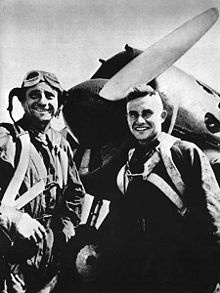
The pilots nicknamed the aircraft Ishak (Russian: Ишак, Donkey/Hinny) because it was similar to the Russian pronunciation of "I-xvi" ("ee-shestnadtset"). When Functioning Barbarossa erupted on 22 June 1941, one,635 of 4,226 VVS aircraft were I-16s of all variants, fielded by 57 fighter regiments in borderland areas.[22] The main assault delivered by the Luftwaffe'due south Luftflotte 2 (in support of Wehrmacht Army Grouping Centre) was directed against the Soviet Western Special Military District, that deployed 361 (424 according to other sources) I-16s.[23] During the early on phase of the campaign the I-sixteen bases were the main targets for the German aircraft and after 48 hours of combat, of the 1,635 Polikarpov monoplanes in service on 21 June 1941, only 937 were left.[24] Past thirty June the number of I-16s in western front line units had dropped to 873, including 99 that required repairs.[25] To stalk the Luftwaffe aerial assault several I-sixteen pilots adopted the taran tactic and sacrificed their lives, ramming German language aircraft.[25]
Its main opponent in the sky in 1941 was the German Messerschmitt Bf 109.[26] The I-16 was slightly more than maneuverable than the early Bf 109s and could fight the Messerschmitt Bf 109E, or Emil, on equal terms in turns. Skilled Soviet pilots took reward of the Polikarpov's superior horizontal maneuverability and liked it enough to resist the switch to more modernistic fighters. The German language aircraft, yet, outclassed its Soviet opponent in service ceiling, rate of climb, acceleration and, crucially, in horizontal and diving speed, due to amend aerodynamics and a more powerful engine. The main versions of the I-16 had a maximum speed of 450–470 km/h (279–291 mph), while the Bf 109E had a maximum speed of 560–570 km/h (347–353 mph), the more streamlined Bf 109F Friedrich could hit 615–630 km/h (372-390plus mph). Then German pilots held the initiative and could decide if they wanted to chase their opponents, could attack them from above and behind so gain altitude for a new attack. Meanwhile, Polikarpovs could merely defend each other by forming a defensive circle or via horizontal maneuverability.[26]
Moreover, in terms of armament, Messerschmitts had a slight edge on the I-sixteen. The Emil carried ii wing-mounted 20mm MG FF cannons and two synchronized 7.92 mm MG-17s with a weight of a one-second salvo of 2.37 kg, while the near common version of the I-16 – armed with just two synchronized and two wing-mounted vii.62 ShKAS – could evangelize i.43 kg of bullets each 2d.[27] Finally, the armament storage on a Messerschmitt exceeded that of the I-16, carrying 1,000 rounds for each motorcar gun (plus sixty drum-housed rounds for each cannon), while the Polikarpov carried just 450 rounds for each ShKAS gun.[28]
Around half of all produced I-16s were still in service in 1943, when they were finally replaced.[ citation needed ]
Specially modified I-16s were used in the Zveno parasite aircraft experiments using the Tupolev TB-3 as a mothership.
The Luftwaffe was known to have captured some I-16 and UTI-4 two-seat trainers (ii of which were marked with the Stammkennzeichen codes DM+HC and DM+Hard disk drive) and flown from the Erprobungstelle Rechlin key Luftwaffe exam facility by Kampfgeschwader 200 (KG 200).[29] The Luftwaffe was not the only air force able to test its fighters against the I-16; the Japanese captured a few I-16s too,[3] and the Romanian Air Force likewise got one when a Soviet pilot defected.[30] The Finnish Air Force (FAF) captured some I-16s (forth with several other Soviet types). During the Winter War and the Continuation State of war, the Finns captured half-dozen I-16s and i I-16UTI. Two of the captured I-16s and I-16UTIs were put back into flying condition and flight tested.[31]
Variants [edit]
There is considerable disagreement in literature on features of particular I-16 variants. This list is based on the following references.[32] [33] [34]
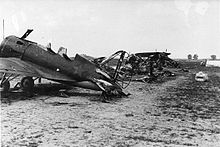
Russian Polikarpov UTI-4, a two seater training version of the I-16 Soviet fighter. Russia 1941.

- TsKB-12
- First prototype, G-22 engine, 336 kW (450 hp), two unsynchronized ShKAS machine guns in the wings with 900 rpg.
- TsKB-12bis
- Second prototype, Wright SGR-1820-F-three Cyclone engine, 533 kW (715 hp)
- TsKB-12P (I-16P)
- Epitome armed with two ShVAK cannon in the wings, 150 rpg.
- TsKB-18
- Footing attack prototype with M-22 engine and armored cockpit. Armed with four ShKAS or PV-one machine guns and 100 kg (220 lb) of bombs. Two boosted Blazon 5s were fitted with vi ShKAS machine guns of which four could reject to 20° for ground strafing.
- TsKB-29 (SPB)
- Pneumatically-operated landing gear and flaps, Wright Cyclone engine, armament of 2 ShKAS machine guns, used as a high-speed swoop bomber in the Zveno project
- I-16 Type 1
- Pre-production series, Thousand-22 engine with 358 kW (480 hp).
- I-16 Blazon 4
- First production version, Chiliad-22 engine.
- I-xvi Blazon 5
- Type iv with a streamlined and tapered engine cowling, Shvetsov Yard-25 engine with 522 kW (700 hp). 2 prototypes tested with M-62 engine as well. Mass-produced.
- I-xvi Type half-dozen
- Shvetsov M-25B engine, 545 kW (730 hp). Weight reduction downwards to 1383 kg.
- I-16 Type 10
- Four ShKAS automobile guns (two synchronized in the fuselage and two in the wings), windscreen replaced the sliding canopy, could be fitted with retractable skis for winter operations, M-25B engine with 560 kW (750 hp). Hispano-Suiza-built shipping were powered past the Wright Cyclone R-1820-F-54 engine.
- I-16 Type 12
- Version of I-16 Type v with 2 ShKAS machine guns and ii ShVAK cannons.
- I-xvi Type 16
- Blazon 10 with synchronized ShVAK 12.7mm prototypes. Only three were built, all in January 1939, with serial numbers 16211-16213. They passed manufacturing plant trials and were delivered to the VVS for military trials.[35]
- I-16 Type 17
- Type 10 with 2 ShKAS machine guns and two ShVAK cannon, condom tail bike, M-25V engine with 560 kW (750 hp). Some aircraft were fitted with an boosted 12.7 mm (0.5 in) Berezin UB automobile gun for strafing.
- I-16 Blazon 18
- Type 10 with Shvetsov M-62 engine producing 620 kW (830 hp), with a ii-speed supercharger and a variable-pitch propeller. Capable of carrying two 100 fifty (26 US gal) underwing fuel tanks.
- I-xvi Type nineteen
- Identical to the Type x, except for the replacement of their fly-mounted ShKAS automobile guns with Savin–Norov machine guns; the propeller-synchronized ShKAS were not replaced. Only 3 aircraft were built in this configuration, all in Jan 1939. They had series numbers 19211-19213. They were outset used as test platform for the new gun and then delivered to the VVS equally I-16SN. They saw activity during the Winter State of war.[35] [36]
- I-16 Type 20
- This designation was first applied to four prototypes congenital in Feb 1939 at Factory 21 and armed with Savin–Norov (SN) machine guns synchronized to fire through the propeller. This blazon was nevertheless rejected in Baronial 1939, and and so the designation reused for the commencement I-16 version (otherwise the same equally the type 10) capable of carrying driblet tanks. These 93 50 (25 U.s.a. gal) tanks were designated PSB-21. Eighty shipping of this specific type were delivered. Additionally, all I-xvi types built subsequently January 1940 could utilise these drop tanks.[35]
- I-16 Type 21 and Type 22
- These were planned to take four synchronized machine guns all firing through the propeller. Type 21 was to use only ShKAS, while type 22 was supposed to use a mixture of ShKAS and SN machine guns. Both types however existed only on paper; no aircraft of these types went into service.[35]
- I-xvi Type 23
- Type 10 additionally armed with RS-82 rockets; 35 were built starting in May 1939. Further production of this type was cancelled in August 1939.[35]
- I-16 Blazon 24
- Four ShKAS, landing flaps replaced drooping ailerons, tailwheel added, 2nd cockpit door added on the starboard side, Shvetsov One thousand-63 engine with 670 kW (900 hp).
- I-xvi Type 27
- Type 17 with an Chiliad-62 engine.
- I-16 Type 28
- Type 24 with two ShKAS and two ShVAK.
- I-sixteen Type 29
- Two synchronized ShKAS in the nose and a single 12.7 mm (0.l in) UBS in the lesser of the fuselage; it had no guns in wings which were reserved for basis attack weapons. Three rocket racks were mounted in each wing. Additionally, starting in 1941, the external fuel tank hardpoint was changed so that it became multipurpose: it could carry the new type of driblet tank, PLBG-100, or a FAB-100 bomb. Wartime photographs from the summer of 1941 evidence 2 configurations: one with 6 RS-82 rockets and two FAB-100 bombs and another with iv RS-132 rockets.[37]
- I-16 Blazon 30
- Re-entered production in 1941–42, Yard-63 engine.
- I-16TK
- Type 10 with a turbocharger for improved high-altitude performance, reached 494 km/h (307 mph) at 8,600 m ( 28,200 ft), did not enter production.
- UTI-1
- Ii-seat trainer version of Type 1.
- UTI-2
- Improved UTI-i with fixed landing gear.
- UTI-iv (I-16UTI) likewise known as I-16 Type 15
- Two-seat trainer version of Type v, most with fixed landing gear. This model was built in meaning numbers, approximately 3,400 were produced.[38]
Operators [edit]

Chinese I-16 (Communist china Aviation Museum)
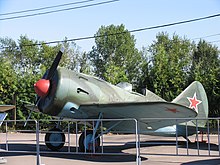
Aircraft on display at a museum in Moscow
-
 China
China
- Chinese Nationalist Air Force
-
 Nazi Deutschland
- Luftwaffe operated captured aircraft
-
 Finland
- Finnish Air Strength operated captured aircraft.
-
 Mongolia
- Mongolian People's Army Aviation operated one I-16 used for grooming
-
 Poland
- Polish Air Force operated i I-16 (1 Pułk Lotnictwa Myśliwskiego) and ii UTI-4 aircraft (xv Samodzielny Zapasowy Pułk Lotniczy and the Techniczna Szkoła Lotnicza.[39]
-
 Romania
- Royal Romanaian Air Forcefulness one captured aircraft, one I-16 was captured near Dorohoi in 1941.
-
 Soviet Union
- Soviet Air Forces
- Soviet Naval Aviation
-
 Spanish Commonwealth
- Spanish Republican Air Forcefulness
-
 Castilian State
- Spanish Nationalist Air Force operated I-16 and UTI-4 aircraft captured from the Spanish Republican Air Force, returned by French authorities and 30 congenital in Jerez de la Frontera. I-16s were still operated in 1952.
- Grouping ane-W
- 26th Group
- Morón Fighter School
Surviving aircraft [edit]

This aircraft is property of The Infante de Orleans Foundation
Commencing in 1993, New Zealand pilot and entrepreneur Sir Tim Wallis' Alpine Fighter Collection organised the restoration of 6 I-16s and 3 I-153s, constitute in Russia, to an airworthy condition past the Soviet Aeronautical Research Institute (Sibnia) in Novosibirsk.[40] [41] [42] The flight of the first restored aircraft (I-xvi 9) took place in Oct 1995. Once restored the aircraft were transported by rail to Vladivostok and from there shipped via Hong Kong to New Zealand. This project was completed in 1999 when the tertiary and last I-153 arrived in New Zealand. In addition a seventh I-xvi was later restored for American collector Jerry Yagen.
Communist china [edit]
- Unknown – I-sixteen on static display at the Chinese Aviation Museum in Datangshang.[43] It is believed to be a replica incorporating original parts.[ citation needed ]
Finland [edit]
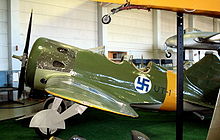
- UT-1 – I-xvi UTI-4 on static display at the Finnish Aviation Museum in Vantaa, Uusimaa.[44]
Deutschland [edit]
- 2421319 – I-16 Type 24 airworthy with a private owner in Federal republic of germany as D-EPRN.[45]
Russian federation [edit]
- 2421234 – I-xvi Type 24 airworthy with a private possessor in Russian federation every bit RA-1561G.[46]
- 2821395 – I-16 on static display at the Central Naval Museum in Saint Petersburg.[47] [48]
- Replica – I-16 on static display at the Museum of the Smashing Patriotic State of war in Moscow.[49]
- Unknown – I-16 on static display at the Central Air Force Museum in Monino.[fifty]
Espana [edit]
- 2421039 – I-16 Blazon 24 airworthy at the Fundación Infante de Orleans in Madrid as EC-JRK.[51] [52] [53]
- Replica – I-16 on static display at the Museo del Aire in Madrid.[54] [55]
Us [edit]
- 2421014 – I-16 Type 24 airworthy at the Flight Heritage Collection in Everett, Washington as N7459.[56] [57]
- 2421028 – I-xvi Blazon 24 airworthy at the Military Aviation Museum in Virginia Beach, Virginia equally N1639P.[58] [59] [threescore]
- 2421645 – I-16 Type 24 to be restored to airworthy condition past Kermit Weeks,[61] at Fantasy of Flight as N30425.[62] [63]
Specifications (I-16 Type 24) [edit]

3-view cartoon of Polikarpov I-xvi
Data from Istoriia konstruktskii samoletov 5 SSSR exercise 1938[33]
General characteristics
- Coiffure: One
- Length: 6.thirteen thou (xx ft ane in)
- Wingspan: 9 grand (29 ft 6 in)
- Height: 3.25 k (ten ft eight in)
- Wing area: fourteen.5 m2 (156 sq ft)
- Airfoil: TsAGI R-II (16% at root)[64]
- Empty weight: 1,490 kg (3,285 lb)
- Gross weight: i,941 kg (four,279 lb)
- Powerplant: 1 × Shvetsov M-63 9-cylinder supercharged air-cooled radial engine, 820 kW (1,100 hp)
- Propellers: 2-bladed variable-pitch propeller
Performance
- Maximum speed: 489 km/h (304 mph, 264 kn) at iii,000 m (9,800 ft)
- Range: 700 km (430 mi, 380 nmi) with driblet tanks
- Service ceiling: 9,700 m (31,800 ft)
- Rate of climb: 14.seven m/s (2,890 ft/min)
- Fourth dimension to altitude: five,000 m (xvi,000 ft) in 5 minutes 48 seconds
- Wing loading: 134 kg/m2 (27 lb/sq ft)
- Ability/mass: 0.43 kW/kg (0.26 hp/lb)
Ammunition
- 2 × fixed forrad-firing 7.62 mm (0.300 in) ShKAS auto guns in upper cowling
- 2 × fixed forrad-firing 20 mm (0.787 in) ShVAK cannons in the wings
- six × unguided RS-82 rockets or upwardly to 500 kg (1,100 lb) of bombs
Come across likewise [edit]
- Zveno projection
Aircraft of comparable role, configuration, and era
- Brewster F2A Buffalo
- Boeing P-26 Peashooter
- Fiat K.50
- Macchi MC.200
- Messerschmitt Bf 109
- Mitsubishi 1MF10
- Nakajima Ki-27
- Reggiane Re.2000
- Seversky P-35
Related lists
- List of interwar military aircraft
- Listing of aircraft of World War II
- List of aircraft of the Spanish Republican Air Force
References [edit]
Notes [edit]
- ^ Maslov 2008, p. 76.
- ^ Greenish, William. "Polikarpov's Little Hawk". Flying Review, November 1969.
- ^ a b c Liss 1966, p. 10.
- ^ Abanshin and Gut 1994, p. 38.
- ^ Léonard 1981, pp. xviii–22.
- ^ Blitheness of the I-16's maingear retraction cycle
- ^ Animation of the I-16'due south lower mainwheel door mechanics during retraction
- ^ Jackson 2003 p. 148.
- ^ Jackson 2003, p. 147.
- ^ Gunston 2003, p. 85.
- ^ Maslov 2010, p. 25.
- ^ Maslov 2010, p. 26.
- ^ Maslov 2010, p. xxx.
- ^ Maslov 2010, p. 32.
- ^ Kotelnikov p. 109
- ^ Nedialkov 2011, p. 141.
- ^ Nedialkov p. 24, 25, 148
- ^ Toll 1975, p. 78.
- ^ 红岩春秋, 唐学锋 (17 Jan 2019). "当年设施简陋的梁山机场,没想到却是中国空军保卫重庆的第一道空中防线! - 上游新闻·汇聚向上的力量". www.cqcb.com . Retrieved fifteen January 2021.
"5•xx"梁山空战,我空军击落日机7架,这是当时新闻媒体报道的数字,难免有些夸大。根据南京的中国第二历史档案馆保存的《空军战斗要报》记载:此役,我空军一共击落敌轰炸机3架、侦察机1架。其大致情况如下:1、第24队队长李文庠,分队长张光蕴、王文骅、队员彭均、李廷凯等5员,在梁山上空合力击落敌重轰炸机1架(残骸在寻觅中)。2、队员陈少成在忠县上空击落敌侦察机1架,该敌机在忠县汝溪焚毁,番号为258,敌乘员3人全毙。3、队员伍国培在梁山上空击落敌重轰炸机1架,该机在忠县马家祠损毁,番号为4528,敌乘员6人全毙。4、分队长韩参在开县击落敌重轰炸机1架,敌机残骸正寻觅中。从当天中国空军的战斗要报记载来看,被击落的4架日机,只有两架是查明了具体坠落的地点,并找到了残骸,而另外两架的残骸还在"寻觅"中。
{{cite web}}: CS1 maint: url-condition (link) - ^ Cheung, 2015, pp. 67-68. The 24th PS/4th PG received a small number of the ShVAK 20mm cannon-armed I-16 Type 17 fighters from the Soviets, and were used to skillful result intercepting 24 G3Ms and a Ki-fifteen (C5M) on twenty May 1940
- ^ NASA Technical Translation. National Aeronautics and Space Administration. 1959.
- ^ Maslov 2010, p. 68.
- ^ Maslov 2010, pp. 68–69.
- ^ Maslov 2010, p. 69.
- ^ a b Maslov 2010, p. 72.
- ^ a b Drabkin 2007, p. 142.
- ^ Drabkin 2007, pp. 142–43.
- ^ Drabkin 2007, p. 143.
- ^ Thomas 2004, p. 80.
- ^ Stapfer 1996, p. 46.
- ^ Perttula, Pentti. "FAF in Colour." [ permanent expressionless link ] saunalahti.fi. Retrieved: 6 September 2009.
- ^ Liss 1966, p. 8.
- ^ a b Shavrov 1985
- ^ Green 2001, pp. 473–475.
- ^ a b c d eastward Маслов М. А. (2008). Истребитель И-xvi. Норовистый "ишак" сталинских соколов (in Russian). Яуза / Коллекция / ЭКСМО. pp. 55–57. ISBN978-5-699-25660-0.
- ^ С.В. Иванов (2001). И-16: Боевой "Ишак" сталинских соколов. Часть two . Война в воздухе (in Russian). Vol. 43. ООО "АРС".
Раньше чем начались испытательные стрельбы ультраШКАСа, два инженера, Савин и Норов, представили в 1935 г. на испытания еще один авиационный пулемет СН скорострельностью 2800–3000 выстрелов в минуту. В 1936 г. пулемет успешно прошел стрельбовые испытания, а в 1937 г. был рекомендован к серийному производству. Пулеметами СН немедленно вооружили истребители И-16; И-16 с пулеметами СН получили обозначение тип 19, несмотря на то, что кроме вооружения самолет ничем не отличался от И-16 тип ten. Пулеметами СН заменили крыльевые ШКАСы, синхронные пулеметы остались прежними – ШКАСы. В начале 1939 г. завод № 21 изготовил три И-16 тип 19 (заводские номера 192111, 19212 и 19213). С 17 по 26 марта самолеты испытывал заводской летчик-испытатель Томас Сузи. По результатам испытаний было рекомендовано построить партию таких самолетов. Но массовое производство посчитали нецелесообразным. Под обозначением И-16СН истребители передали в ВВС. Весной 1939 г. на вооружение ВВС РККА был принят авиационный пулемет ультраШКАС. Истребители, вооруженные ультраШКАСАми и СН, приняли участие в войне с Финляндией зимой 1939–1940 г.г.
- ^ Маслов М. А. (2008). Истребитель И-16. Норовистый "ишак" сталинских соколов (in Russian). Яуза / Коллекция / ЭКСМО. pp. 144–145. ISBN978-5-699-25660-0.
- ^ Маслов М. А. (2008). Истребитель И-16. Норовистый "ишак" сталинских соколов (in Russian). Яуза / Коллекция / ЭКСМО. p. 76. ISBN978-5-699-25660-0.
- ^ Stapfer 1996, p. 50.
- ^ Peat. Pages 219 to 224.
- ^ "Polikarpov I-sixteen 'Ishak' ('Rata')". Kiwi Shipping Images. Phillip Treweek. Retrieved 9 December 2016.
- ^
- ^ "Airframe Dossier – Polikarpov I-xvi". Aerial Visuals. AerialVisuals.ca. Retrieved 9 December 2016.
- ^ "POLIKARPOV UTI-four ( I-16 UTI)". Ilmailumuseo Flygmuseum (in Finnish). Suomen ilmailumuseo. Retrieved nine December 2016.
- ^ "Aircraft D-EPRN Information". Airport-Information.com. Airport-Data.com. Retrieved 9 December 2016.
- ^ "Airframe Dossier – Polikarpov I-xvi-24 Rata, c/northward 2421234, c/r RA-1561G". Aerial Visuals. AerialVisuals.ca. Retrieved nine December 2016.
- ^ "[Untitled]". Aviation of World War II. AirPages. Retrieved 9 December 2016.
- ^ "[Untitled]". Aвиация Второй мировой (in Russian). AirPages. Retrieved 9 December 2016.
- ^ "Airframe Dossier – Polikarpov I-16, s/n 61 white VVS". Aerial Visuals. AerialVisuals.ca. Retrieved 9 December 2016.
- ^ "Airframe Dossier – Polikarpov I-16". Aerial Visuals. AerialVisuals.ca. Retrieved 9 Dec 2016.
- ^ "Policarpov I-16 Mosca/Rata". Fundación Infante de Orleans (in Spanish). Fundación Infante de Orleans. Retrieved 9 December 2016.
- ^ "Airframe Dossier – Polikarpov I-xvi-24 Rata, s/n 39 Russian AF, c/n 2421039, c/r EC-JRK". Aeriform Visuals. AerialVisuals.ca. Retrieved 9 December 2016.
- ^ "REGISTRO DE MATRÍCULA DE AERONAVES CIVILES" (PDF). Agencia Estatal de Seguridad Aérea. 1 December 2016. Archived from the original (PDF) on 20 December 2016. Retrieved 9 December 2016.
- ^ "Hangar three del Museo de Aeronáutica y Astronáutica" (in Spanish). Ejército del Aire. Archived from the original on 18 November 2016. Retrieved ix Dec 2016.
- ^ "Airframe Dossier – Polikarpov I-16 Rata (Replica)". Aerial Visuals. AerialVisuals.ca. Retrieved 9 December 2016.
- ^ "POLIKARPOV I-sixteen TYPE 24 (RATA)". Flying Heritage Collection. Friends of Flying Heritage. Archived from the original on 6 April 2015. Retrieved nine Dec 2016.
- ^ "FAA REGISTRY [N7459]". Federal Aviation Administration. U.S. Department of Transportation. Retrieved nine December 2016.
- ^ "WWII – Aircraft". Armed services Aviation Museum. Military Aviation Museum. Archived from the original on 9 October 2013. Retrieved 9 December 2016.
- ^ "Polikarpov I-16 "Rata" Fighter Factory". Fighter Factory. Fighter Factory. Archived from the original on 21 May 2011. Retrieved 9 December 2016.
- ^ "FAA REGISTRY [N1639P]". Federal Aviation Assistants. U.S. Department of Transportation. Retrieved nine December 2016.
- ^ Archived at Ghostarchive and the Wayback Automobile: Kermit Weeks (20 March 2019), Polikarpov I-16 Soviet Fighter - New Conquering ??? , retrieved 21 March 2019
- ^ "Airframe Dossier – Polikarpov I-xvi-24 Rata, c/n 2421645, c/r N30425". Aeriform Visuals. AerialVisuals.ca. Retrieved 9 December 2016.
- ^ "FAA REGISTRY [N30425]". Federal Aviation Administration. U.S. Department of Transportation. Retrieved 9 Dec 2016.
- ^ Lednicer, David. "The Incomplete Guide to Airfoil Usage". m-selig.ae.illinois.edu . Retrieved sixteen April 2019.
Bibliography [edit]
- Abanshin, Michael E. and Nina Gut. Fighting Polikarpov: Eagles of the E No. two. Lynnwood, WA: Aviation International, 1994. ISBN i-884909-01-9.
- Cheung, Raymond. OSPREY AIRCRAFT OF THE ACES 126: Aces of the Democracy of China Air Forcefulness. Oxford: Bloomsbury Publishing Plc, 2015. ISBN 978 14728 05614.
- Drabkin, Artem. The Cherry Air Force at State of war: Barbarossa and the Retreat to Moscow – Recollections of Fighter Pilots on the Eastern Front. Barnsley, Southward Yorkshire, UK: Pen & Sword War machine, 2007. ISBN 1-84415-563-3.
- Gordon, Yefim and Keith Dexter. Polikarpov's I-16 Fighter: Its Forerunners and Progeny (Red Star, vol.3). Earl Shilton, Leicester, Uk: Midland Publishing Ltd., 2002. ISBN 1-85780-131-8.
- Gordon, Yefim and Dmitri Khazanov. Soviet Gainsay Aircraft of the Second World War, Volume One: Single-Engined Fighters. Earl Shilton, Leicester, Uk: Midland Publishing Ltd., 1998. ISBN 1-85780-083-iv.
- Light-green, William and Gordon Swanborough. The Great Volume of Fighters. St. Paul, Minnesota: MBI Publishing, 2001. ISBN 0-7603-1194-iii.
- Light-green, William & Swanborough, Gordon. "Soviet Flies in Spanish Skies". Air Enthusiast Quarterly, No. ane, n.d., pp. 1–16. ISSN 0143-5450
- Green, William and Gordon Swanborough. WW2 Aircraft Fact Files: Soviet Air Force Fighters, Part 2. London: Macdonald and Jane's Publishers Ltd., 1978. ISBN 0-354-01088-3.
- Gunston, Bill. The Illustrated Directory of Fighting Aircraft of Globe State of war 2. London: Salamander Books Express, 1988. ISBN 1-84065-092-three.
- Kotelnikov, Vladimir R. Air State of war Over Khalkhin Gol, The Nomonhan Incident. (2010) SAM Publications. ISBN 978-1-906959-23-iv.
- Kopenhagen, W., ed. Das große Flugzeug-Typenbuch(German). Stuttgart, Germany: Transpress, 1987, ISBN 3-344-00162-0.
- Jackson, Robert. Aircraft of globe state of war II – Development – Weaponry – Specifications. London, Amber Books, 2003. ISBN 978-i-85605-751-vi.
- Léonard, Herbert. Les Avions de Chasse Polikarpov (in French). Rennes, France: Editions Ouest-France, 1981. ISBN 2-85882-322-7.
- Léonard, Herbert. Les Chasseurs Polikarpov (in French). Clichy, French republic: Éditions Larivière, 2004. ISBN ii-914205-07-four.
- Lesnitchenko, Vladimir (November–December 1999). "Combat Composites: Soviet Use of 'Mother-ships' to Behave Fighters, 1939–1941". Air Enthusiast (84): 4–21. ISSN 0143-5450.
- Liss, Witold. The Polikarpov I-16 (Shipping in Profile Number 122). Leatherhead, Surrey, UK: Profile publications Ltd., 1966.
- Maslov, Mikhail A. Polikarpov I-15, I-sixteen and I-153 Aces. Oxford, U.k.: Osprey Publishing, 2010. ISBN 978-1-84603-981-ii.
- Маслов, М.А. Истребитель И-xvi. Норовистый «ишак» сталинских соколов. Москва: Коллекция, Яуза, ЭКСМО, 2008. Maslov M.A. Istrebitel' I-sixteen. Norovisty "ishak" stalinskih sokolov (I-16 Fighter. A Restive "Donkey" of Stalin's Falcons). Moscow, Russia: Collection, Yauza, EKSMO, 2008. ISBN 978-v-699-25660-0.
- Nedialkov, Dimitar. In The Skies of Nomonhan: Nippon verses Russia, May–September 1939. London: Crecy Publishing Limited, 2nd edition 2011. ISBN 978-0-859791-52-6.
- Peat, Neville (2005). Hurricane Tim : The Story of Sir Tim Wallis (Hardback). Dunedin: Longarce Printing. ISBNone-877361-17-8.
- Price, Alfred. The Earth War II Fighter Conflict. London: Macdonald and Jane's (Publishers) Ltd., 1975. ISBN 0-356-08129-X.
- Shavrov V.B. Istoriia konstruktskii samoletov v SSSR do 1938 chiliad. (3 izd.) (in Russian). Moscow: Mashinostroenie, 1985. ISBN 5-217-03112-iii.
- Shavrov V.B. Istoriia konstruktskii samoletov v SSSR, 1938–1950 gg. (3 izd.) (in Russian). Moscow: Mashinostroenie, 1994. ISBN 5-217-00477-0.
- Stapfer, Hans-Heiri. Polikarpov Fighters in Action, Function 2 (Aircraft in Activity number 158). Carrollton, TX: Squadron/Indicate Publications, Inc., 1996. ISBN 0-89747-355-viii.
- Thomas, Geoffrey J. KG 200: The Luftwaffe's Most Secret Unit. London: Hikoki Publications, 2004. ISBN i-902109-33-3.
- 徐 (Xú), 露梅 (Lùméi). 隕落 (Fallen): 682位空军英烈的生死档案 - 抗战空军英烈档案大解密 (A Decryption of 682 Air Force Heroes of The War of Resistance-WWII and Their Martyrdom). 东城区, 北京, 中国: 团结出版社, 2016. ISBN 978-vii-5126-4433-v.
External links [edit]
- "The I-16 Fighter" resources
- I-xvi Fundación Infante de Orleans
Source: https://en.wikipedia.org/wiki/Polikarpov_I-16

Post a Comment for "Rata & Co Face Mask Vitamin C Reviews"