Ancient Greek Men in Greek Art That Potrays That They Were Given Respect
Artists and writers accept been looking dorsum to the ancient world for hundreds of years. The colourful stories have inspired endless works of fine art and literature, but these depictions have possibly tended to bear witness only a limited perspective on the mythology. Of the translations, art, verse and literature we're nigh familiar with, the creators tend to be pretty united nations-diverse – being largely white, male person and typically middle class. The works accentuated the heroic and powerful while downplaying other elements of ancient Greek lodge such as homosexuality, gender imbalances and slavery.
In some ways, this reflects the patriarchal gild of ancient Greece, where women typically didn't seem to have had many rights – they weren't able to own property, vote or inherit
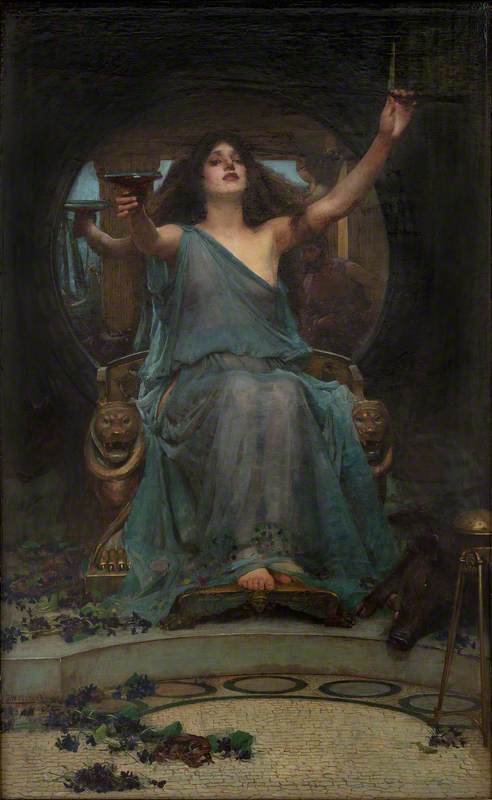
Circe 1891
John William Waterhouse (1849–1917)
Gallery Oldham
Accept Circe the witch, for example. When Odysseus and his crew wash upward on her island, she uses her seductive charms and magical powers to outwit most of the men – turning them into pigs – but her attempts to overcome Odysseus are foiled past a tip-off from the god Hermes. She subjects herself to Odysseus'southward will, turning the coiffure back to humans and hosting them all for nearly a year. Circe bears his child before he leaves, homeward bound (or so he thinks) back to his married woman and family in Ithaca. She's typically portrayed every bit mysterious, manipulative and is frequently thought to human activity every bit a alert to men against the dangers of seductive women.
In John William Waterhouse's painting Circe at Gallery Oldham, she'southward shown with a placid, welcoming expression and in a near transparent dress, offering a cup of wine to her guest Odysseus (seen in the mirror). Viewers familiar with the poem volition know that Odysseus needs to be careful! The vino is laced with a magic potion, the results of which can be seen at her feet – one of Odysseus's crew turned into a squealer. 'Beware of seductive women' is the clear message here.
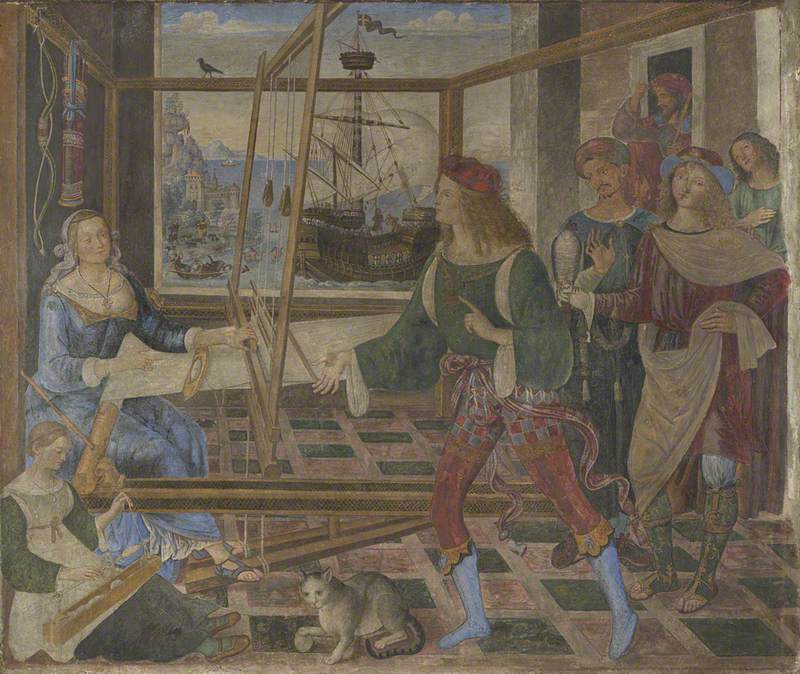
Or take Odysseus's married woman, Penelope, who patiently and loyally waits for 20 years for her married man to return home from the Trojan wars. Her agency is limited to stoically enduring the difficulties of having an absent-minded hubby/king, forced to put up with the suitors vying to take Odysseus's place. She's often celebrated for her chasteness and loyalty to her hubby. She spends the two decades at habitation rejecting the advances of other
In this painting past
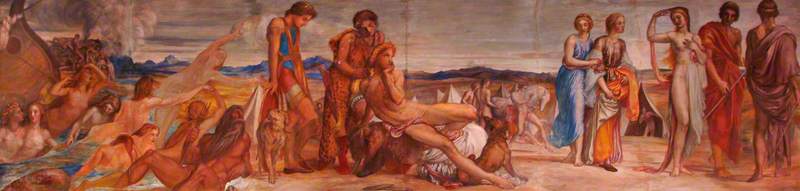
This gender imbalance plays out in many stories from the ancient world and reflects the patriarchal society which produced them. Slavery, too, played a major part in the economy of the ancient Greeks. In the Iliad, Briseis – the erstwhile queen of a conquered city – is treated as a possession who can be passed from one owner to the adjacent.
In this George Frederick Watts painting, she'south shown being led away from i master, Achilles, to her new owner, Agamemnon. The artist portrays Briseis looking dorsum at Achilles longingly. Watts is more concerned about the romantic tragedy and ignores the fact that Achilles actually owns Briseis and was probably more upset nearly being publicly disrespected by Agamemnon than losing his concubine.
The versions of the stories which we take received, translations from Greek, Latin, Arabic, Hebrew and then into English language and other modern languages accept recurring themes of treating women and other social groups poorly. These patriarchal societies interpreted the stories from their own perspectives and produced works which showed women and other peoples as junior and propagated values of 'otherness'. By heralding figures from classical mythology, artists and writers from the Renaissance onwards gave justification to the violent acts existence committed on those 'lesser' or 'other' in their ain times. Europe was going through huge changes, developing empires, conquering and enslaving other peoples – much as the Greeks and Romans did.
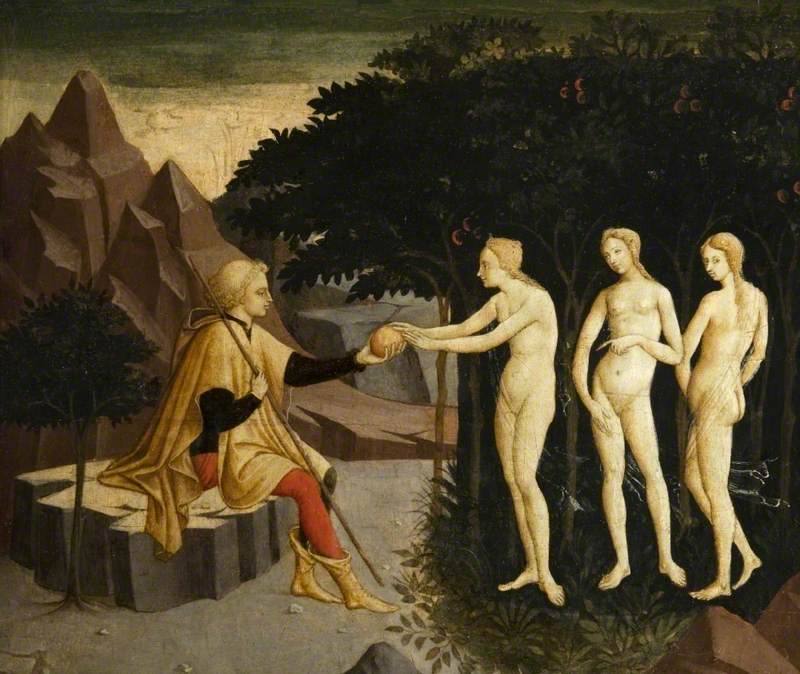
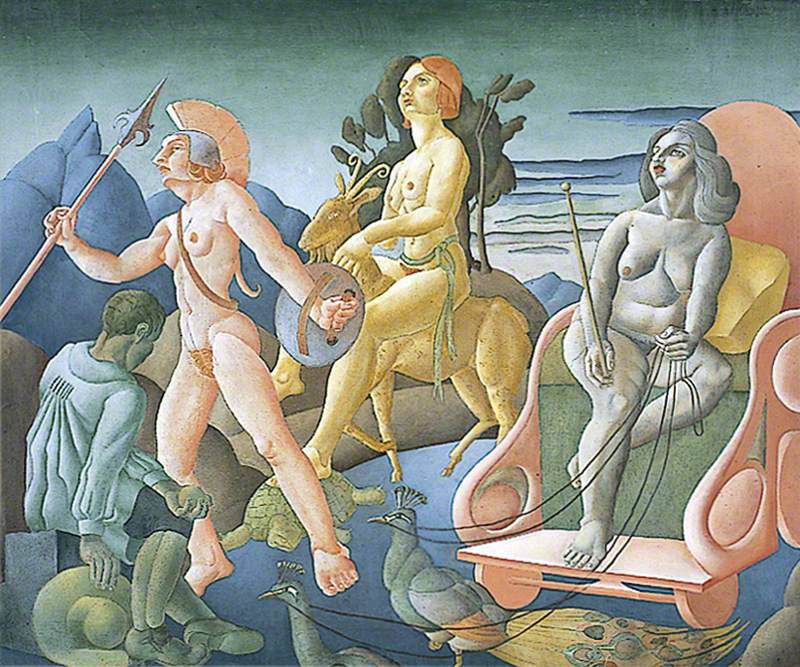
At that place are, however, some voices which question the traditional representation of the Greek myths. Artists like Ithell Colquhoun take also been fatigued to the rich and fascinating aboriginal Greek globe merely have chosen to show it in a different way. If you lot compare her painting The Judgment of Paris with a fifteenth-century example from The Burrell Collection on the same topic, you lot tin see that in Colquhoun'south version the three goddesses – Athena, Aphrodite and Hera – are presented in all their divine glory with Paris, who sits head bowed and humbled. The power dynamic in the piece of work by the Chief of the Judgement of Paris, on the other paw, is quite different. Here the iii goddesses are meek and vulnerable in front of a mere mortal such as Paris. Colquhoun's are much more muscular, powerful and
Her Scylla likewise represents a figure from antiquity. In the Odyssey, Scylla is a ferocious ocean monster who prowls a narrow cliff-sided strait, pouncing on unwary sailors and eating them whole. Colquhoun'south version becomes almost a
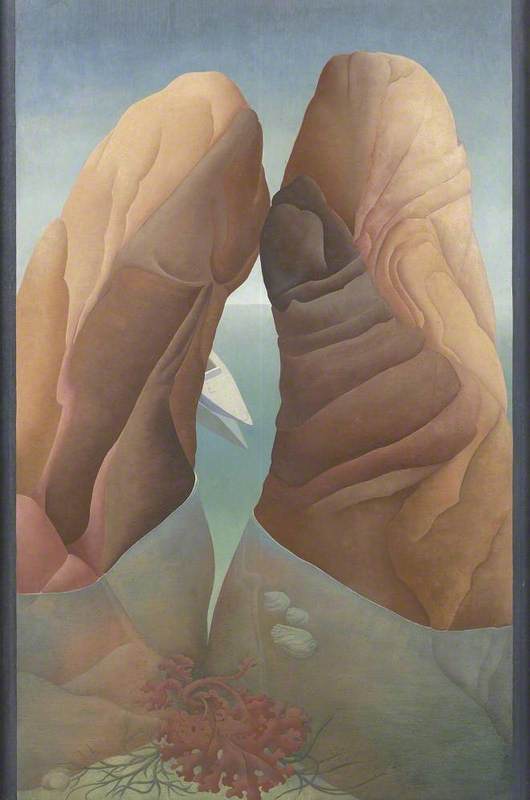
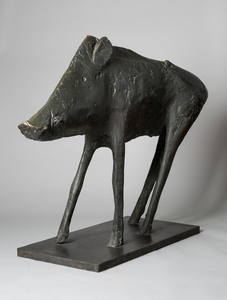
Elisabeth Frink's '
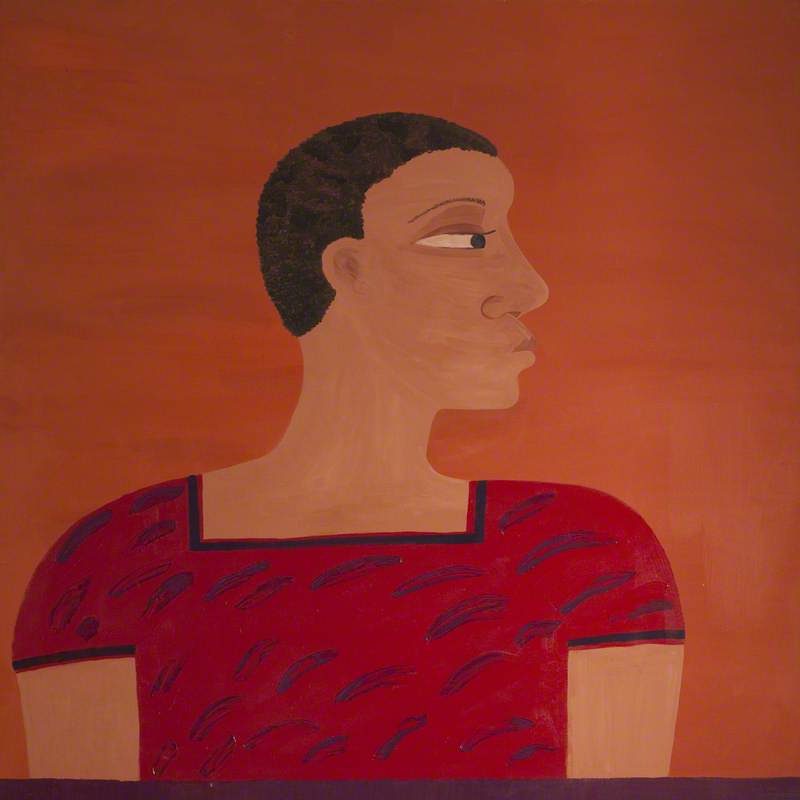
Lubaina Himid's painting Hannibal'due south Sister draws attention to the lack of representations of both powerful women and people of color from art depicting the classical globe. The Greeks and Romans were Mediterranean powers after all, with North Africa but existence a boat ride away. People of colour were certainly present in the stories – the Egyptians, Ethiopians and Carthaginians being obvious examples – but why are and so few represented in the art produced to describe this mythology?
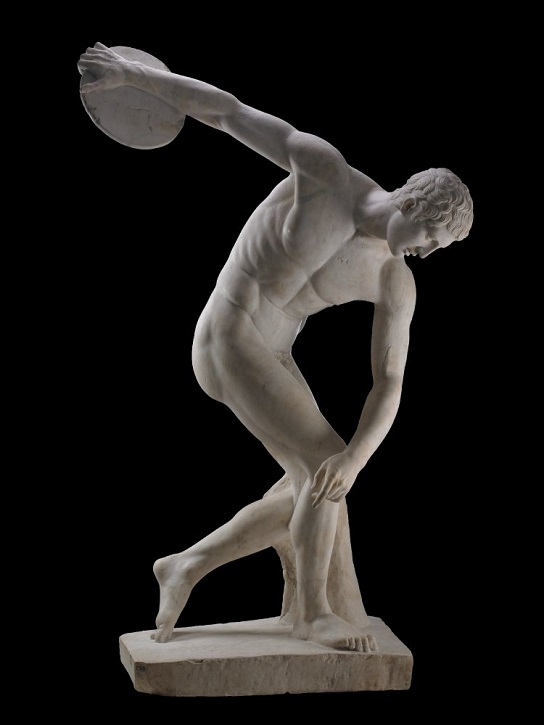
The Townley Discobolus
2nd century Advert marble copy of a 1st century BC bronze original by Myron
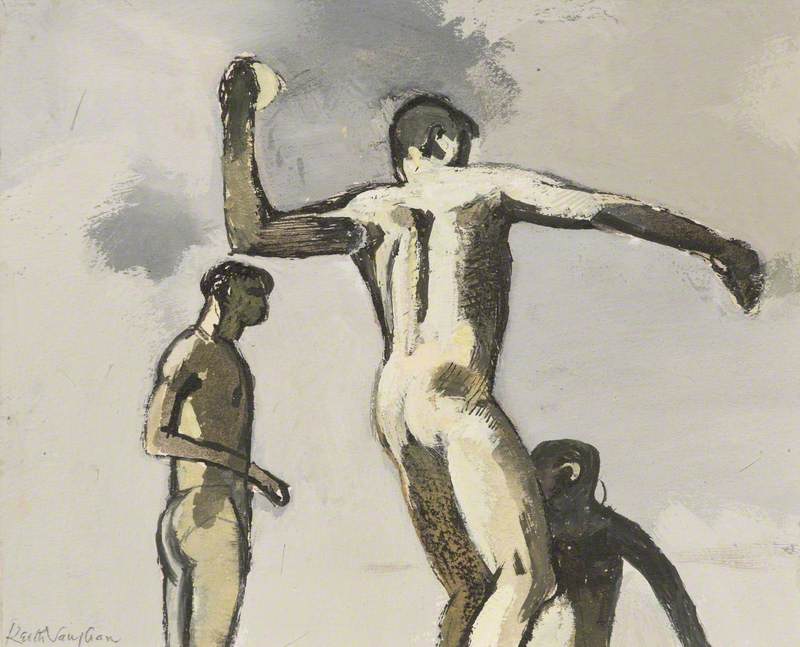
Whilst same-sex relationships accept been present in the Greek myths (see Achilles and Patroclus, or Apollo and Cyparissus), artworks and translations oftentimes skipped over the nature of these relationships. Pylades becomes Orestes' 'friend' or the erotic nature of Zeus' infatuation with Ganymede was omitted. Many gay male artists have reclaimed stories from ancient Greece and Rome, highlighting how same-sex relationships were visible and respected in ancient Greece. Keith Vaughan's depictions of naked men have a clear heritage in the athletic sculpture of Greece and Rome. In his humorous and erotic cartoon Minotaur and Homo, the Minotaur, oft seen as a symbol of male person sexuality, is shown in the middle of an act that men in the ancient Greek world would have probably been very familiar with.
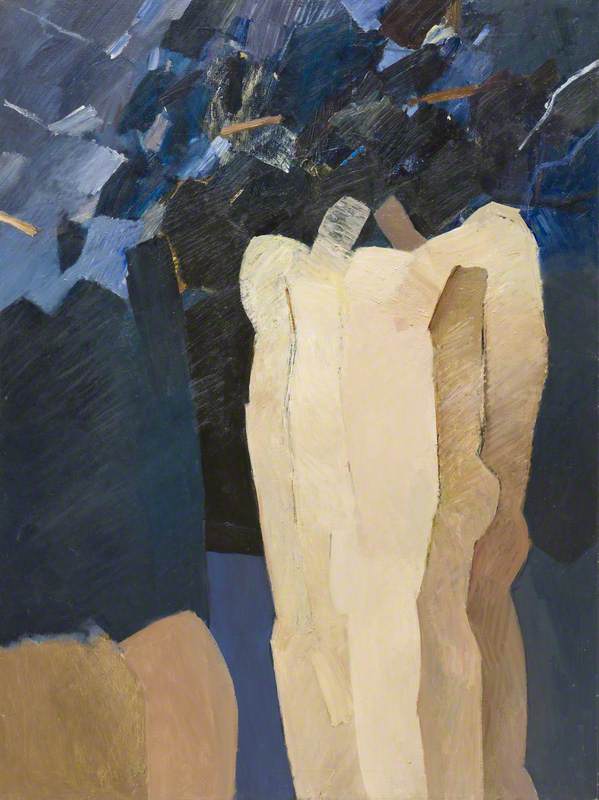
Two Figures 1966
John Keith Vaughan (1912–1977)
Amgueddfa Cymru – National Museum Wales
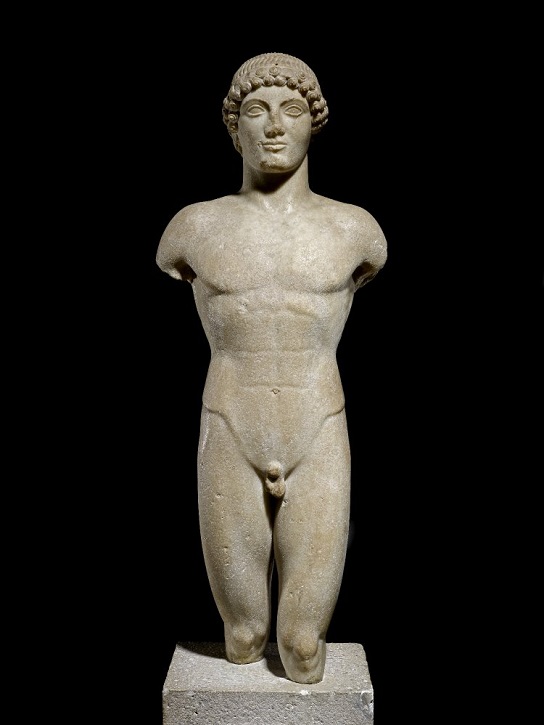
The Strangford Apollo
490 BC, marble by Greek School
Perhaps the fine art made past Colquhoun, Frink,
Iain Calderwood, Image Officeholder at Art U.k.
More stories
Artworks
Learning resources
-

-
Activity
Make a wool sculpture
KS3 (ENG)
KS3 (NI)
CfE L3 (SCO)
KS3 (WAL)
KS2 (ENG)
KS2 (NI)
CfE L2 (SCO)
KS2 (WAL)
-
-
-

-

-

-
Source: https://artuk.org/discover/stories/how-art-reinterprets-greek-mythology-from-problematic-patriarchies-to-queer-perspectives

Post a Comment for "Ancient Greek Men in Greek Art That Potrays That They Were Given Respect"